The journey, mapped
Every step your customer takes, and where it gets hard.
 Perseid Echo
Book a call
Customer experience design
Every customer walks a path: finding you, asking, booking, being served, coming back. I find where that path breaks, then fix the handoffs, scripts and steps behind it, so it feels easy on both sides of the counter.
The real thing
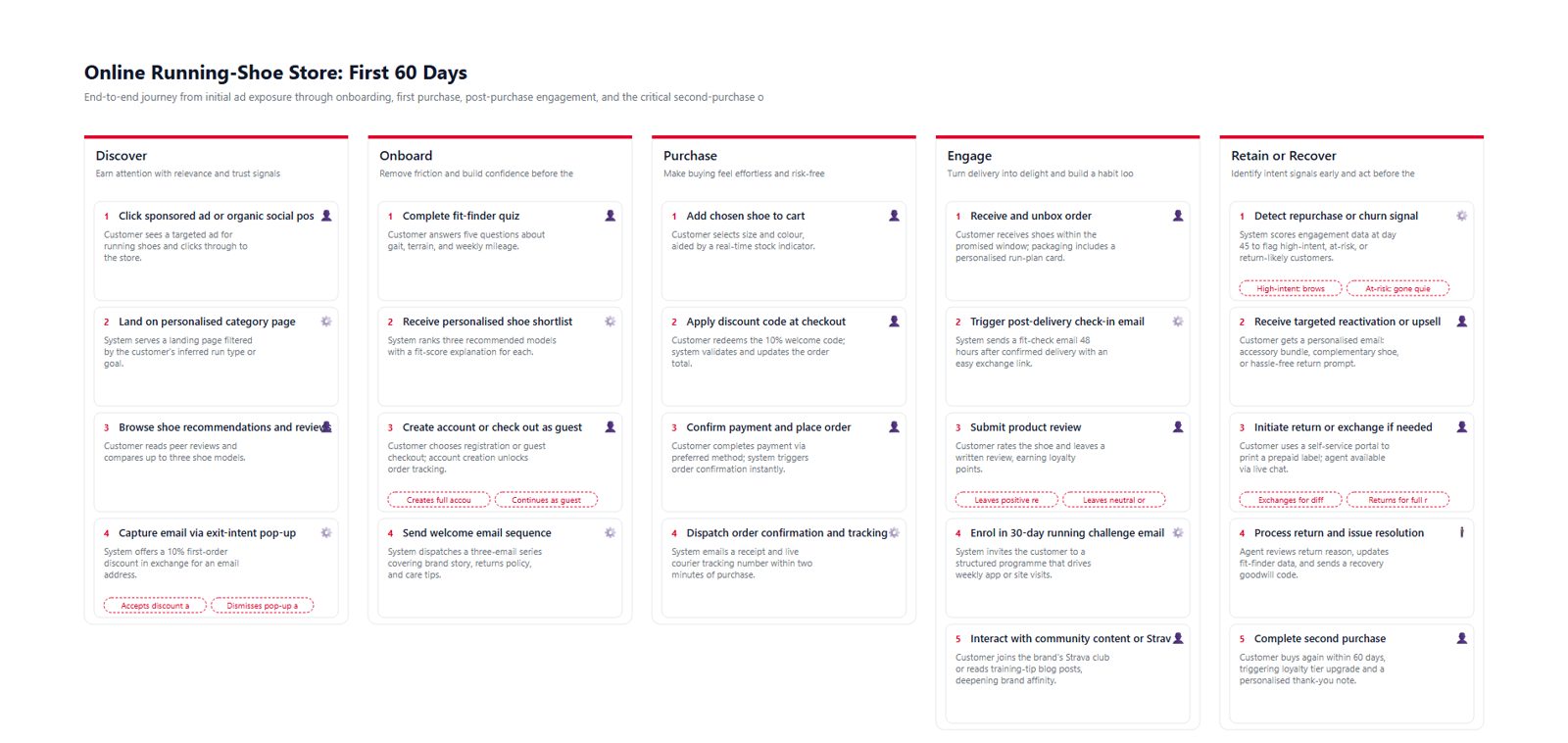
Every step a customer takes, stage by stage, drawn with my own journey-mapping tool. This one is a sample online shop, not a client.
Every step your customer takes, and where it gets hard.
Who does what at each handoff, written down.
Simple procedures, scripts and checklists for the front line.
Agreed signs of improvement, checked after the change.
A quick read on where to start.
Together, from the first call to the follow-up.
Put the changes in place, then measure what changed.
More than 21 years in customer experience and operations: service journeys, frontline procedures, and making change stick.
Proof from the floor
Figures describe documented scope, not a forecast of your results.
Work order 01
Internal workflow tool, from my customer experience work
Created a field-driven tool that turned structured journey inputs into leadership-ready flows. It removed repetitive PowerPoint formatting, from box alignment to text spacing, and was adopted by most of an approximately 20-person design team.
Work it takes off a person: Designers could spend more time on the journey and cross-team decisions instead of recreating the presentation.
Work order 04
Client project, family client, quoted with permission
Built the vendor invitation emails, sign-up tracking and payment collection for a home care technology buyer's guide, and kept its pages and categories easy to change.
Work it takes off a person: Searching for updated contact emails and keeping track of bouncebacks and replies by hand.
“Bryan took over and automated absolutely everything about the backend workings while leaving the customer-facing part intact. He saved me hours, perhaps weeks, of busy work. And now my service is ready to go, months sooner than I could have released it using my manual methods.”
Tim Rowan · Public 5-star Google review
Disclosure: Tim is my stepfather, which is how I got the job, and why he had no reason to be polite about it. The review is public on Google.

Who you are dealing with
I am Bryan. For more than 21 years, I worked across customer experience and operations: improving service journeys, shaping frontline procedures, helping teams support new products, and bringing different functions together to make change work.
No. The point is a working change: new steps, guidance and tools your team actually uses.
Yes. Most of this work is with owner-led businesses and small teams.
Only where it helps. Sometimes the fix is a clearer message or a better checklist, not new technology.
You own and control what is built for your business. You get the credentials, the configuration, the documentation, and a plain-English owner's guide: everything needed to run it or hand it to someone else.
Fair question. Everything is documented well enough for another competent person to pick it up, monitored so problems announce themselves instead of going quiet, and built on tools you can access without me.
Before anything is built, you get it in writing: what the work touches, which outside services process it, what is stored and for how long, and who has access. If any of that is not acceptable to you, we design around it or we do not build it.
One short call. You talk to the person who does the work.
Book a free 20-minute call